
Ephesus, one of the most renowned ancient cities of the Mediterranean world, is located in present-day Turkey, near the town of Selçuk. Its history spans several millennia, making it a key archaeological and historical site. Ephesus was a vibrant city, significant for its commerce, politics, and culture, and it played a crucial role in the spread of early Christianity.
Ancient writers largely agree that Ephesus was founded sometime between 1500 and 1000 B.C, and this is supported by archaeological evidence at the site. Later, it appears that lonians settled in the cities of lonia. According to legend, under the leadership of Androklos, son of Kodros, the migrants arrived in Anatolia, and asked their sages where their new city should be established.
The sages prophesied that a wild boar and a fish would lead them to the site of the new settlement. One day, Androklos, himself a new migrant from Greece, was cooking fish on an open fire, when a fish flew from the pan into the nearby bushes. Sparks from the fire also ignited the bushes, and as they flared up, a wild boar ran out of the bushes to escape from the flames. Androklos pursued and killed the boar. Then recalling the words of the wise men, he built his city on this site, which is at a place about 1200 metres west of the Artemision, where the original city of Ephesus was founded. The cities of lonia were later joined together in a federation entitled the Ionian confederacy. Androklos, the city’s first king, died in battle with the Carians, and the Ephesians erected a memorial to their first monarch. In the 7th century B.C, Ephesus was invaded by the Cimmerians, who razed the city to the ground, and burnt what they could, including the temple of Artemis. After this, Ephesus Tours was ruled by a series of tyrants.
Throughout its later history, consequent to this early setback, Ephesus seemed protected from harm by the gods, and prospered either through chance or through the politics of its citizens. In the 6th century B.C, the Artemis temple was restored by the Lydian King, Croesus, who resettled the inhabitants of around the temple. But when Croesus was defeated in battle with the Persians Ephesus fell under Persian rule, along with the other cities of lonia. One of the most important features of the city was that it was an important port which served to link Sardis to Susa. The Ephesians used this factor to their own advantage in many ways. Miletus, for example, had been destroyed and burnt down during the Ionian invasion, although it had been a trade rival of Ephesus. By deciding not to support the Milesians, they both strengthened their own position, and improved trade opportunities.
Ephesus Tours
Alexander the Great showed a great interest in this city as he passed through Anatolia, largely because of the significance he accorded to the temple of Artemis. After Alexander, a similar interest was shown by his commander Lysimachos, who had the city’s harbour, which had already begun to silt up at that time, dredged of river silt. Thanks to his efforts, the city was able to carry on as a trading centre for some time. Lysimachos also helped to build a new Ephesus as a fortified town between Mt. Pion and Mt. Koressos. These fortifications had walls 10 metres high and covered an area 9 kms. in length. The city was further expanded by migrants who moved there from Lebedos and Colophon. It was during this period that Ephesus was adorned with a theatre, a staqium and a gymnasium.
In 88 B.C., the Ephesians allied with Mithridates, the ruler of Pontus against the Romans, and succeeded in killing thousands of Roman troops, but later began to realise the extent of the Roman strength and changed sides. This made them not only an ally of Rome, but also caused Rome to appoint Ephesus as the capital of the Asian province. Until the 1st century AD., the Ephesians enjoyed generally good relations with neighbouring states and with Rome, due to successful diplomacy. However, this did not protect them from the force of an earthquake which hit the city in 17 AD, and destroyed it completely. During the reign of the emperor Tiberius, the city was reconstructed and enlarged. Later, it was adorned with shrines and other buildings during the reign of Hadrian. The new city bore the definite seal of Roman architecture, in place of the Hellenistic city. It retained its political and mercantile supremacy during this period, and began to have religious significance during the Christian era, as it was said to have been the place of residence chosen by the mother of Christ after his crucifixion. However, the harbour began to silt up once again, and it gradually declined as a trading centre. Completely blocked with silt, the city became uninhabitable, and during the reign of the Emperor Justinian (527 -564 AD.) the inhabitants moved to the hills of Ayasoluk, where the same emperor built the basilica of St. John. The new settlement, which had been fortified, fell to the Turks in 1090.
Now let us visit the Museum of Ephesus to look at the statue of Artemis Ephesia, the altar of the Temple of Domitian, the Socrates frescos and the Theodosian reliefs from the temple of Hadrian. After studying these beautiful artefacts, we may move on to the basilica of St. John on the slopes of Ayasoluk. This magnificent basilica was built during the 6th century AD. by the emperor Justinian, and dedicated to St John. The entrance to the basilica was on the western façade, and the plan of the church was cruciform. The narthex was covered with a single cupola, and the church proper with six domes supported on columns. Under the central dome was situated the tomb of St John.
On the eastern end of the church were bays arranged in a semi-circle, used by the priests during ceremonies. The floors are mosaic, and to the north of the tomb are frescos on which are depicted several of the saints. In the centre is the figure of Christ, and to his left is that of St John and a priest The basilica has been restored several times, and on the capitals of several of the columns be seen the monograms of the Emperor Justinian and the empress Theodora. In 1869, an Englishman named Wood discovered the site of the Artemision. Excavations were carried out after this in 1904 by another Englishman named Hogarth. In 1895 the temple was first excavated by an Austrian team, and it is Austrians who are presently engaged in excavational work around the site.
Founding and Early History
The origins of Ephesus date back to the 10th century BCE when it was founded by Greek colonists from Athens. According to legend, the city was established by Androclus, a prince of Athens, who followed the oracle of Delphi’s guidance to settle there. Ephesus was strategically positioned near the Aegean Sea, which allowed it to thrive as a major trading hub. Early on, the city was influenced by the Lydians, who ruled the region until the 6th century BCE, when it came under Persian control.
Hellenistic Period
The Hellenistic period was a time of great prosperity for Ephesus. After the conquest of Alexander the Great in 334 BCE, the city was liberated from Persian rule. Lysimachus, one of Alexander’s generals, played a significant role in the development of Ephesus. He relocated the city to a new site around 300 BCE due to frequent flooding and rebuilt it on a grid plan. During this period, Ephesus became one of the most important cities in the Greek world, known for its impressive architecture, including the Temple of Artemis.
The Temple of Artemis
The Temple of Artemis, also known as the Artemision, was one of the Seven Wonders of the Ancient World. Dedicated to the goddess Artemis, the temple was a massive structure, larger than the Parthenon in Athens. It was completed around 550 BCE and was known for its grandeur and intricate marble sculptures. The temple attracted pilgrims from across the ancient world and played a central role in the city’s religious and economic life. Unfortunately, the temple was destroyed by a fire set by Herostratus in 356 BCE and was later rebuilt, only to be ultimately destroyed by the Goths in 262 CE.
Roman Era
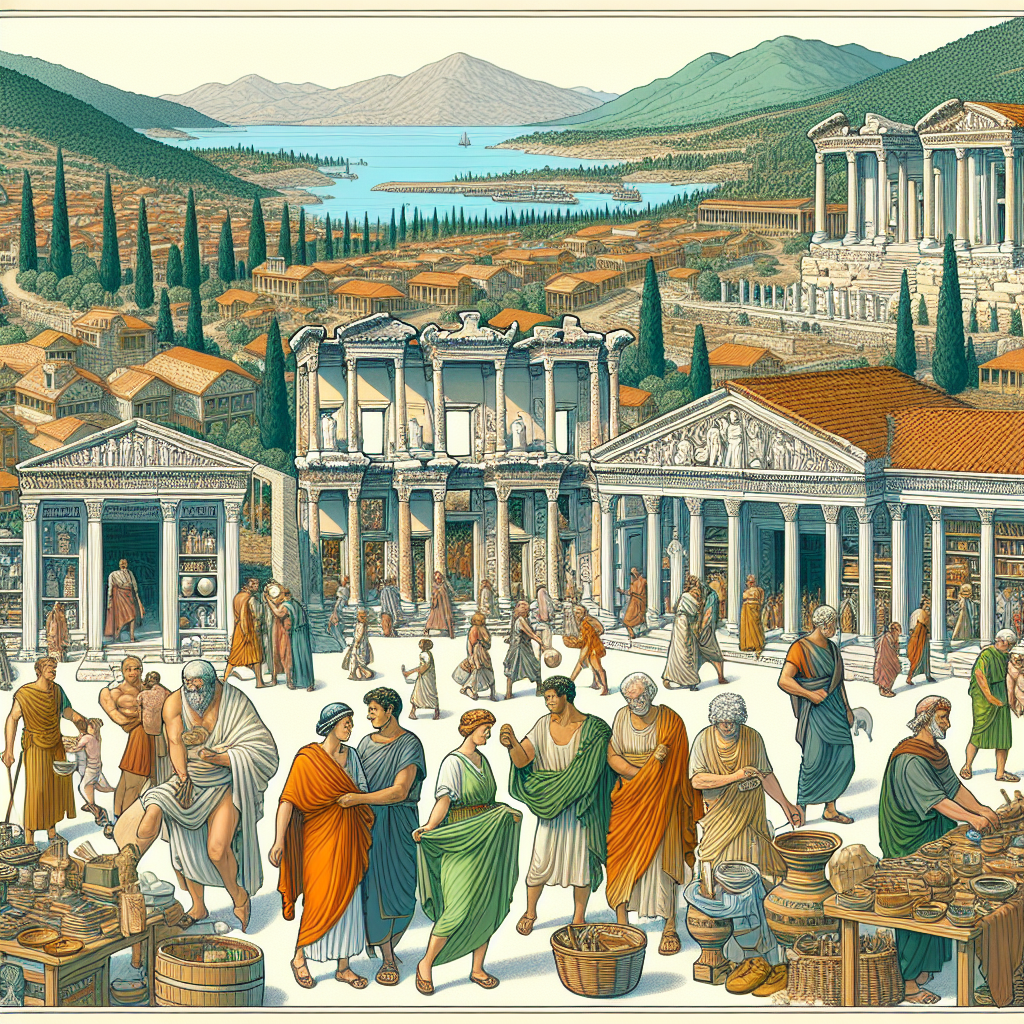
Ephesus reached its zenith during the Roman period. In 129 BCE, the city became part of the Roman Empire, and it flourished under Roman rule. Ephesus was designated the capital of the Roman province of Asia, and its population swelled to over 250,000, making it one of the largest cities in the Roman world. The city was known for its magnificent buildings, such as the Library of Celsus, the Grand Theater, and the Temple of Hadrian.
The Library of Celsus, completed in 117 CE, was one of the most impressive libraries of the ancient world, housing thousands of scrolls. The Grand Theater, which could seat up to 25,000 people, was a hub for entertainment and public gatherings. Ephesus also became a major center for the worship of the emperor, with the construction of the Temple of Domitian.
Christianity in Ephesus
Ephesus played a vital role in the early history of Christianity. The city is mentioned several times in the New Testament, and it was the site of significant Christian events. The Apostle Paul spent several years in Ephesus, preaching and establishing the Christian church. The city is also traditionally associated with the Apostle John, who is believed to have lived there in his later years, along with the Virgin Mary, who is said to have spent her last years in a house near Ephesus.
In 431 CE, the city hosted the Third Ecumenical Council, also known as the Council of Ephesus, where key Christian doctrines were debated and established. This council was particularly important in defining the nature of Christ and affirming the title of Theotokos for the Virgin Mary.
Decline and Legacy
The decline of Ephesus began in the late Roman period. The harbor, which had been crucial to the city’s prosperity, gradually silted up due to the natural process of sedimentation, cutting off Ephesus from the sea. This, combined with invasions and economic decline, led to the city’s gradual abandonment. By the 15th century, Ephesus was largely deserted.
Today, Ephesus is one of the most well-preserved archaeological sites in the world. It attracts millions of visitors each year who come to marvel at its ancient ruins and to walk in the footsteps of history. The site offers a glimpse into the grandeur of the ancient world and the rich cultural tapestry of a city that once stood at the crossroads of East and West.
Conclusion
Ephesus is more than just an archaeological site; it is a testament to the rich history of human civilization. From its early days as a Greek colony to its prominence in the Roman Empire and its role in early Christianity, Ephesus has left an indelible mark on history. The city’s ruins continue to tell the story of a place that was once a bustling metropolis, filled with life, culture, and faith.